Star-Devouring Black Hole Spotted by Astronomers: A Rare Discovery at the Edge of a Galaxy
Astronomers have discovered something unusual in deep space: a dormant supermassive black hole hiding far away from the center of its host galaxy. The object remained practically invisible until a passing star came too close and was torn apart by its immense gravity.
The discovery is giving scientists a new opportunity to study a type of black hole that is normally extremely difficult to find.
A Black Hole Hiding in the Outer Regions of a Galaxy
Supermassive black holes are usually associated with the centers of large galaxies. They can contain millions or even billions of times the mass of the Sun, but finding one becomes much harder when it is not actively feeding.
That is what makes this discovery unusual.
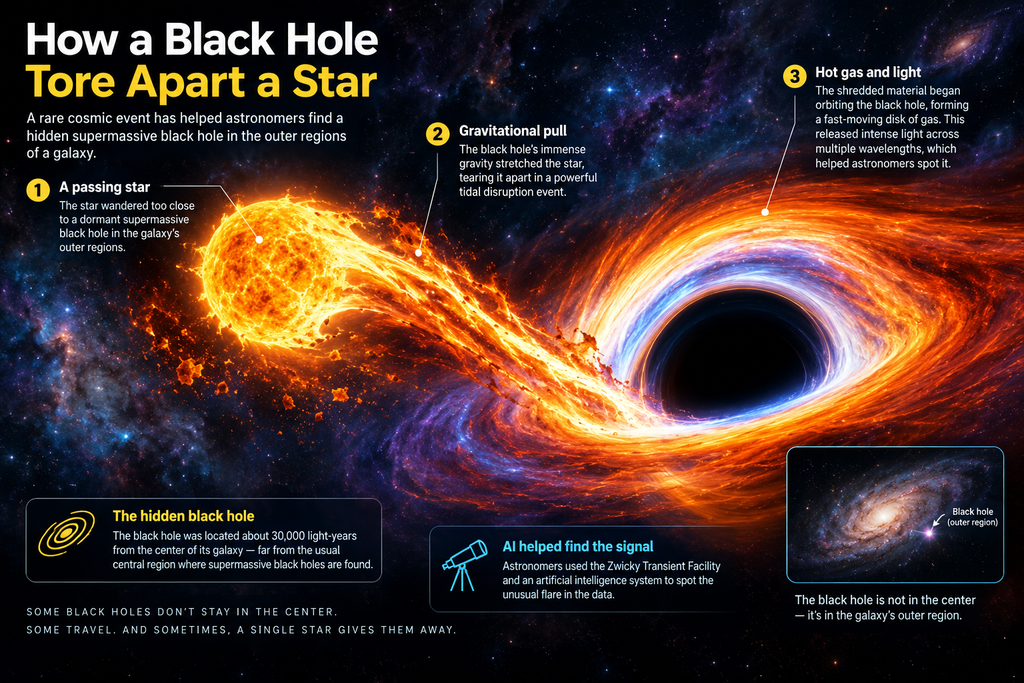
Researchers identified the black hole roughly 30,000 light-years from the center of its host galaxy. Instead of sitting in the familiar central region, it appears to be wandering through the galaxy’s outer parts.
Scientists believe such objects may be left behind after galaxies interact or merge. During these enormous cosmic encounters, a black hole can potentially be pushed away from the center and continue traveling through its surrounding galaxy.
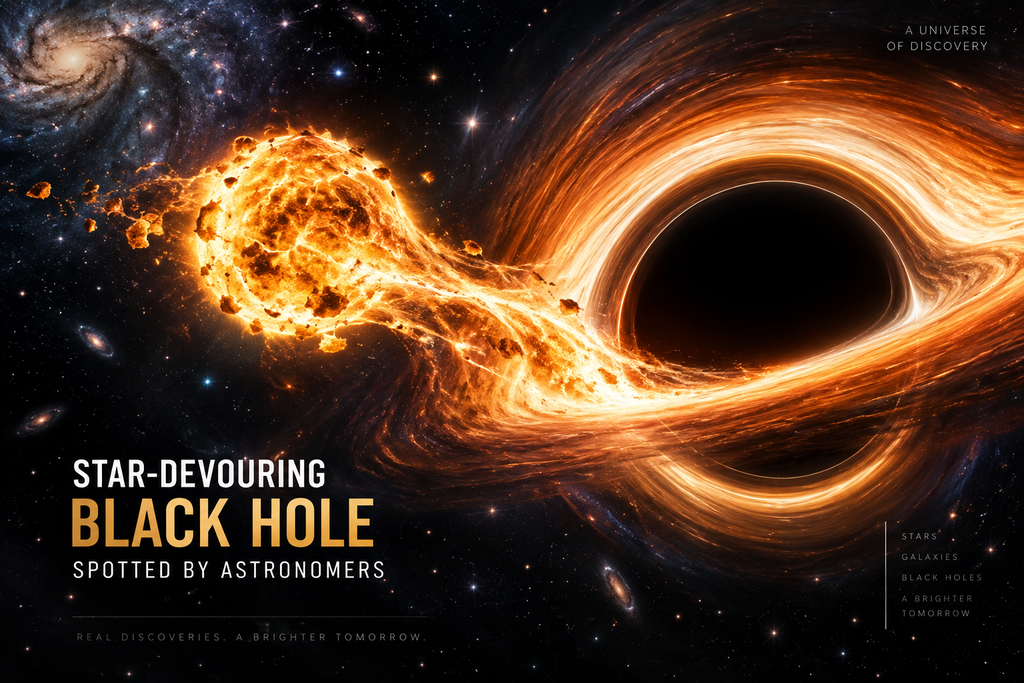
The Star That Revealed Its Location
The black hole would probably have remained hidden if it had not encountered a star.
When the star passed too close, the black hole’s gravitational pull became strong enough to overcome the star’s own structure. The star was stretched and eventually ripped apart, producing a powerful flash of light.
Astronomers call this type of event a tidal disruption event, or TDE.
These events are particularly useful because black holes themselves do not produce visible light. Instead, scientists often detect them through the radiation released by material falling toward them.
In this case, the sudden flare effectively acted like a cosmic signal, revealing the location of an otherwise quiet black hole.
How Astronomers Found the Cosmic Flare
The discovery was connected to observations from the Zwicky Transient Facility (ZTF) at Palomar Observatory in California. ZTF repeatedly surveys large portions of the sky and looks for objects whose brightness changes over time.
That creates an enormous amount of data.
To help search through it, researchers developed an artificial intelligence system capable of recognizing the characteristic patterns associated with tidal disruption events. The system began operating in 2025, and only a few months later it identified the event that led researchers to this distant black hole.
This is an interesting example of how modern astronomy is increasingly combining large astronomical surveys with machine learning and automated data analysis.
What Happens When a Black Hole Eats a Star?
A black hole does not simply swallow a star in one instant.
As the star approaches, the difference in gravitational force across the star becomes enormous. The side facing the black hole experiences a stronger pull than the opposite side. Eventually, the star can be stretched apart into streams of extremely hot material.
Some of that material can begin orbiting the black hole, forming a rapidly changing disk of gas.
The material can become incredibly hot and release radiation across different parts of the electromagnetic spectrum, including visible light, ultraviolet radiation and X-rays. Astronomers can study these signals to learn about the black hole and the physical processes taking place around it.
Why This Discovery Matters
The most interesting part of this discovery is not simply that a black hole destroyed a star. Astronomers have observed tidal disruption events before.
What makes this case different is the black hole’s location.
A dormant supermassive black hole sitting tens of thousands of light-years away from a galaxy’s central region is difficult to detect. Finding one suggests that there could be more wandering or displaced black holes hiding in galaxies that astronomers have not yet identified.
The discovery could also provide clues about the history of galaxies.
When galaxies collide and merge, their central black holes can interact in complicated ways. Studying black holes that appear to have moved away from galactic centers may help researchers understand what happens during these enormous cosmic mergers.
AI Could Change the Search for Hidden Black Holes
Traditional astronomical research often depends on scientists manually examining observations or following up on unusual signals. Modern sky surveys, however, are producing data at a scale that is difficult for humans to inspect one event at a time.
Artificial intelligence can help narrow that search.
By learning the characteristic brightness patterns of tidal disruption events, AI systems can scan huge datasets and highlight unusual candidates for astronomers to investigate.
That does not mean AI replaces astronomers. Instead, it gives researchers another tool for finding rare events that might otherwise be buried among hundreds of thousands of changing objects.
As new observatories collect even larger amounts of data, automated systems could become increasingly important in the search for transient events, black holes and other unusual objects.
A Bigger Picture About the Universe
There is still much scientists do not know about wandering black holes.
Some may have been displaced during galaxy mergers. Others could have different histories that researchers have not yet worked out. Because dormant black holes produce little or no obvious radiation, many could remain hidden until something passes close enough to trigger a visible event.
That makes a star being destroyed more than a dramatic cosmic event. It can become a natural experiment.
By watching the light produced during a tidal disruption event, astronomers can study how matter behaves under extreme gravity and learn more about the environments surrounding massive black holes.
What Comes Next?
The discovery is likely to encourage astronomers to search beyond the traditional locations where black holes are expected to exist.
Future sky surveys will provide more opportunities to catch these brief flashes. Telescopes operating at optical, ultraviolet, X-ray and infrared wavelengths can then be used to investigate the same event from different perspectives.
Researchers will also want to know whether similar dormant black holes are hiding elsewhere in galactic outskirts.
For now, the discovery offers a fascinating reminder that the universe is full of objects that can remain almost completely invisible until the right event gives them away.
A single star wandered too close to a hidden black hole—and in doing so, it helped astronomers uncover an object that may have been quietly traveling through its galaxy for an enormous length of time.